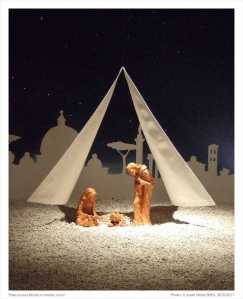
The season of Advent offers an opportunity to reflect on the mystery of the Incarnation. As we prepare Christmas dinners, trees, Nativity scenes and gifts, we risk to take for granted the celebration of the Nativity itself, the birth of our Lord. Perhaps we even lose sight of the depth of the faith we profess. What does it mean, for the believer, to state that God became flesh, and pitched his tent among us?
It seemed therefore good to provide an English version of this conversation.
Our reflection will focus more specifically on one question: are the incarnation and nativity of Jesus only the result of the humanity’s need for redemption? If there hadn’t been original sin, would God have become human anyway? I’m in good company asking this question, with John Duns Scotus, and Pope Benedict.
As you will have picked by now, tonight it will be a more theological kind of conversation. My starting point is a catechises of Pope Benedict, where he cites the Franciscan medieval philosopher-theologian John Duns Scotus (1266-1308). Duns Scotus states, regarding the mystery of the incarnation:
To think that God would have given up such a task [the incarnation] had Adam not sinned would be quite unreasonable! I say, therefore, that the fall was not the cause of Christ’s predestination and that if no one had fallen, neither the angel nor man in this hypothesis Christ would still have been predestined in the same way.
Duns Scotus, Reportata Parisiensis III Sent., d. 7, 4.)
Duns Scotus’ affirmation is, at the same time, powerful and liberating. A theological reflection – in a way – on the prologue to the Gospel of John. Without denying the reality of sin and evil (it’s enough to look around us), or humanity’s need for redemption, Scotus affirmation refused to reduce the mystery of the incarnation to this, does not flatten the extraordinary notion of God who wants to relate to humanity in a direct manner, to bring humanity to fulfilment in Christ. Pope Benedict expresses it this way:
This perhaps somewhat surprising thought crystallized because, in the opinion of Duns Scotus the Incarnation of the Son of God, planned from all eternity by God the Father at the level of love is the fulfilment of creation and enables every creature, in Christ and through Christ, to be filled with grace and to praise and glorify God in eternity. Although Duns Scotus was aware that in fact, because of original sin, Christ redeemed us with his Passion, Death and Resurrection, he reaffirmed that the Incarnation is the greatest and most beautiful work of the entire history of salvation, that it is not conditioned by any contingent fact but is God’s original idea of ultimately uniting with himself the whole of creation, in the Person and Flesh of the Son.
Benedict XVI, General Audience 07.07.2010
Worth noting that for Scotus, redemption is present (and necessary), but is subordinated to incarnation. God will have become human anyway, because God came and dwelt amongst us not only for the sake of redemption. Bring humanity to fulfilment is not only a question of redemption.
In this regard we may recall the teaching of St Athanasius on the incarnation, where he states that the Word of God became human, so that we may become God. (“αὐτὸς γὰρ ἐνηνθρώπησεν, ἵνα ἡμεῖς θεοποιηθῶμεν“, De Incarnatione 53,4)
Read in this manner, incarnation is enriched. Taking a moment in front of the Nativity scene, contemplating this mystery, we may ask:
- What does it mean for me, that is, concretely in my life, that “God become flesh, and pitched his tent amongst us”?
- What dignity do I recognise in my humanity (despite my many limits!) since God himself became flesh?
- How do I feel call to live my humanity to the full, in the image and likeness of God?
- What value do I find in the whole of creation since it is willed by God? What responsibilities follow from this truth?
- Where do I feel the need to grow? To be forgiven? To be redeemed?
Reflecting on this, we may ask the grace, making ours the prayer of Saint Richard of Chichester:
O most merciful Redeemer, friend and brother, may I KNOW you more clearly,
LOVE you more dearly, FOLLOW you more nearly.
 Nova et vetera