The Lenten season invites to conversion, but to get there we need to wake up to the reality of sin. Speaking of sin and evil has become somewhat a taboo subject. Mind you, we Catholics sometimes seem to enjoy wallowing in a sense of guilt — so moving off an unhealthy sense of sin is good. However, we need to be aware of not throwing the baby out with the bathwater. We need to recover a sense of evil: to understand how sin is, by its very nature, bad in itself and bad for us, distancing us from each other and from the good Lord.
Today’s Lectio will look at the biblical story of the tree of good and evil in Genesis 3. Perhaps, we consider it a fairy tale, only good for children. Read (and prayed) careful, it is a rich text, and provides fertile ground for reflection.
[If you’re new to the blog, you may want to start with some suggestions how to pray.]
A preliminary note, or two
Before moving on the reading of the text itself (Genesis 2,25-3,24), it’s good for me to make a couple of preliminary notes, to allow for a fresh reading of the story.
Firstly, no serious biblical scholar today would have an issue recognising the first chapters of Genesis as mythological. This, to be clear, does not make them in any way irrelevant! Rather, the power of these stories — even for the ancient story-tellers — is wisdom transmitted in narrative form. Surely, they are not scientific texts, but rather wisdom stories, transmitting profound truths. Once we understand the form, the literary genre, we can then tap into their wisdom.
Secondly, we usually read Genesis 3 in terms of original sin, with particular influence of Saint Augustine. Here, I will move slightly off this reading. To be clear, the reality of sin, and the need for salvation in our lives, is undoubtedly true. Evil and its consequences emerge clearly in the book of Genesis, where Cain’s envy leads to the murder of his brother (Genesis 4); ultimately, every sin against the other is rooted in fratricide (e.g. Matthew 5, 20-23).
The rich tradition of the Church also offers us other elements for reading. We tend, for example, to imagine Adam and Eve as grown-ups (as we are used to see them represented in art). But it hasn’t always been this way: Saint Ireneus of Lyons (2nd century AD), for example, sees Adam as a child, and therefore not yet wise, and easily deceived (Demonstratio no. 12). Adam is seen as child by other authors of the second century, such as Saint Theophilus of Antioch (Apologia ad Autolycum II, 25) and Clement of Alexandria (Protrepticus XI).
Lectio
After that preliminary comment, I invite you to first reading of Genesis 2,25-3,24 [If you prefer, here on bible.oremus.org NRSV]. As always, it is important to read the text calmly, slowly. Do not let the familiarity with the text lead you to just skim through, ignoring the detail. As with any narrative, it is normal to even imagine the story as you read: I invite you to see the protagonists as children or teenagers, in line with Saint Ireneus.
Once you’ve read the text, some notes and comments can help a deeper reader. Naturally, these notes are not complete or exhaustive, but only a help.
Adam. The story does not give a name to the man. The name Adam simply translates human with the same connection in Hebrew between Adam (human) and adamah (earth) as in Human and humus. The NRSV and many translations — quite correctly — tend not to give a name, but leave it as man. If today we were presented with a story whose main character is called Human, we’d understand immediately that in some way it is the story of an archetype, an every-man. It is correct, therefore, to see the narrative as wisdom story that speak of every human, and therefore us too. It is not only the story of a first Adam, but of every adam.
[2,25] naked, and were not ashamed. The last verse of chapter 2 (the chapter divisions are relatively modern) tells us that the two main characters were not ashamed of their nudity. Saint Ireneus notes that their way of thinking was still innocent as that of children. In several cultures (and many ancient ones) nudity in childhood is totally normal, and has no sexual connotation. Only with the onset of puberty is there a self-consciousness of one’s body.
[3,1] the serpent. The text does not speak of the devil, and only subsequent tradition (including later Biblical books) will read it in this sense, since the serpent here is a tempter and a liar. However, we choose to read it, here the serpent is the figure of the tempter.
[3,1] “You shall not eat from any tree in the garden” In considering the narrative, it is interesting to see that the serpent is lying precisely at the moment when he accuses God of being a liar. God never said that they cannot eat from any tree, but only from the tree in the middle of the garden. At the root of lies, and temptation, are often half truths, far more insidious than downright lies.
the tree that is in the middle of the garden. Here the tree is not specifically named, but the context shows that the reference is to the tree of knowledge of good and evil, mentioned in Genesis 2,16. Saint Teophilus of Antioch (Apologia ad Autolycum XI) offers an interesting reading: for him, the tree itself is good, and so is its fruit; but, man is still too young and immature to receive that wisdom, and God — as a good parent/educator — wanted them to remain simple and honest, not to grow up precociously. The choice of both woman and man in the story, therefore, is similar to the desire to experiment with good and evil typical of adolescence, without the maturity of adulthood, and often harming oneself or others, as a consequence.
[3,4] “You will not die” The temptation here echoes the typical way of thinking of those want to experiment or to incite others to do so. We can almost here the voice: Come on! Are you afraid? Coward! Do you still believe what grown-ups tell you? Perhaps we too, deep down, have a sense of God as a wet blanket who wants to deny us any pleasure and joy, rather than the educator (par excellence) who wants to protect us from what — by its very nature — is harmful for us. On the other hand, without freedom of choice, we cannot even choose the good, we cannot truly love.
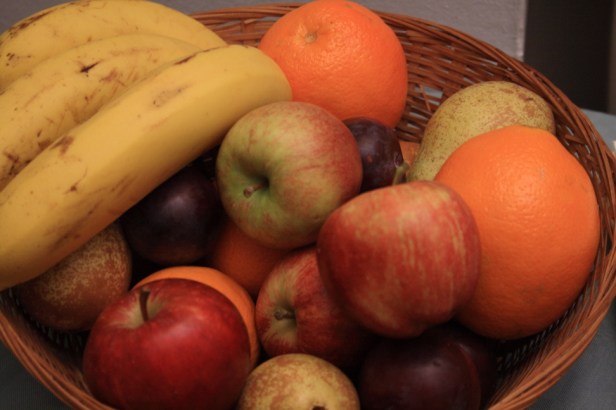
[3,6] its fruit. As you may probably know, the narrative does not name the fruit. The apple come from Latin readings: malum in Latin means apple, but also evil, offering a natural connection.
[3,7] they knew that they were naked. Eating of the tree opened their eyes, since now they know good and evil. Reading with Theophilus, man and woman in the story are like precocious adolescents want to grow too quickly.
they sewed fig leaves together. Several commentators note that fig leaves are irritant … making the first choice of underwear quite uncomfortable! This detail, rather comical for those who understood it, underlines the immaturity and ignorance of man and woman, still unable to make the right choices even in such basic things.
[3,8] hid themselves from the presence of the Lord. Knowledge of good and evil brought them to discover shame. Whoever discovers evil tends to hide from oneself, from others and from God.
[3,12-13] Interesting to note the dynamic: the man blames the woman, the woman blames the serpent. One of the signs of maturity (and its not merely a question of age!) is the ability to recognise one’s own mistakes, one’s own evil, to try and do something about it, and ask forgiveness.
[3,14-18] Several commentators see in these verses an aetiology (i.e., explanation of origin) of three things: the serpent as a slithering beast, and hatred between human and serpent [14-15], the pains of childbirth [16], the hardness of work, and mortality [17-19]. Although these verses are hard to read, it is worth noting that God never curses man or woman.
[3,21] the Lord God made garments of skins. Although the choice of man and woman has its consequences, God remains well disposed towards them, changing the inadequate fig leaves with garments of skin.
[3,23-24] He drove out the man. Ancient mythological language had no other way of speaking than to attribute everything to divine decision and action. If we get the sense of the story, it is the very knowledge of good and evil that made man and women lose Eden. We could see here, in the wisdom story, how children and teenagers, experimenting good and evil, discover that the world is no paradise, that one sweats and suffers. There’s no going back, once that innocence is lost.
Meditatio
Moving on to the second moment, it is good to re-read the scriptural passage, to be able to reflect on ourselves. I propose here a few questions for reflection; feel free to add your own as they emerge in your prayer:
- Where in my life do I recognise moments of Eden, of paradise, of innocence? Where have I — perhaps during adolescence — started to loose that innocence, to discover experientially good and evil? Perhaps also experiment with evil and remaining somewhat wounded/burnt by that encounter?
- Where in my life do I cover my nakedness with fig leaves? Where do I seek to hide my shame, but really end up with more irritation than a real solution? What do I still seek to hide from God? What reality of sin in me still brings about shame? What sin do I still find it hard to confess?
- What is my image of God? A god who is unreasonable, a wet blanket, who does not want us to enjoy the good things in life? Or God who, like a good parent / educator / pedagogue does not want to see me harm myself and others?
- Where do I see that, growing up, I am more mature? Where do I recognise that if I have lost childhood innocence, I have gained maturity (after all, the tree also brings about the knowledge of the good, in contrast to evil)? Where do I still struggle to mature? Where do I still remain very much an adolescent in my relationship with the others and with God?
- Where, in my life, to I experience God as well-disposed towards me, God who takes care of me, who prepares garments for me too?
Oratio
I allow these questions and reflection to open into prayer, speaking to the Lord “as a friend speaks to a friend”. Would would I like to say to the Lord? What would I like to ask? What grace? What leaves me perplexed/confused? What would I like to ask forgiveness for? What do I feel the Lord is trying to tell me? What words of consolation, of love, of wisdom?
I remain in conversation, with the words I find deep in my being. No hurry.
Contemplatio
Finally, I remain in the presence of the Lord, enjoying the Lord’s presence, allowing my prayer to become ever more a prayer of the heart.
I conclude praying the Our Father.
Scripture quotations are from the New Revised Standard Version Bible, copyright © 1989 the Division of Christian Education of the National Council of the Churches of Christ in the United States of America. Used by permission. All rights reserved.
 Nova et vetera
[…] [English version] […]