[Italiano]
Easter invites us to pause before the mystery of the Resurrection. For the Christian, as St Paul reminds us, the truth of Christ’s resurrection is foundational. It is that truth on which everything else is built: without the resurrection of Christ, our faith is devoid of meaning (1 Corinthians 15,14).
Today’s Lectio will focus on the first moment after the resurrection in the Gospel according to John (20,1-9).
A quick note, before moving on: if you are new to this blog you may want to start here, for some practical indications about this blog and how to live Lectio Divina.
Lectio
As we enter into prayer, it is good to express the grace we would like to ask: here we may pray for the gift of discernment, gift of the Holy Spirit, to learn to read the signs, the traces of the passage of the Lord.
Then, I invite you to read calmly this Scripture passage, towards the end of the Gospel according to John (20,1-9) [here on bible.oremus.org NRSV]. As for previous suggestions for prayer, I will only highlight a few elements and comment on them, for a clearer and deeper understanding of the text.
[1] Early on the first day of the week. The reference here is to Resurrection Sunday. Good to recall, however, that in a Hebrew context, the first day is also a reminder of the beginning of creation. The resurrection of Jesus offers a new beginning, a new creation.
saw that the stone, etc. John’s narrative here is very sober. No apparitions (there will be later), no angels, no earthquakes [see note 1]. The sign is simple, almost disappointing: the stone removed, an empty tomb.
[2] the other disciple, the one whom Jesus loved. The text, here as elsewhere in the Gospel, leaves him deliberately anonymous. In many ways, it is the Evangelist himself, the witness to the story. But the literary choice is deliberate: as for the second disciple of Emmaus, the reader is invited to take on the role. The disciple whom Jesus loves is you, and I.
[4-5] outran Peter […] but he did not go in. Peter is slower, but disciple waits. There is a certain gracefulness on the part of the beloved disciple in waiting. The enthusiasm of the young disciple waits for the wisdom of the older one, and respects him. Maybe we could read here too how the charismatic / passionate Church knows how to wait for the hierarchical / institutional Church, because it is important for them to enter together into the empty tomb.
He bent down to look in and saw the linen wrappings lying there. It is interesting to note what he saw. Peter and the beloved disciple saw nothing but the empty tomb and the funerary clothes.
[8] he saw and believed. I find this detail fascinating: the disciple believes on seeing the empty tomb. The sign of absence becomes the sign of the passage of the Lord. He doesn’t see the resurrection, he hasn’t yet seen the Lord, he sees only the traces left behind. For the one who doesn’t discern these traces, not looking through the eyes of faith, the empty tomb is merely an empty tomb. For the beloved disciple, it is far more.
[9] as yet they did not understand the scripture. The sign of the empty tomb become the key to reading the Scripture, and the door into faith.
Meditatio
At this stage, I invite you to re-read the passage, keeping in mind what was noted above. Then I invite you to reflect on these questions, and others that emerge in your prayer.
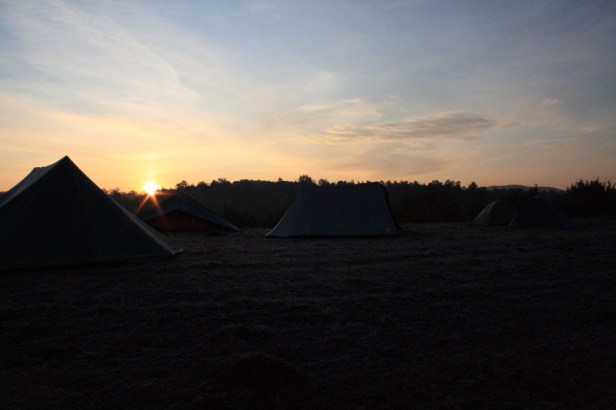
- Scouting, exploring the world of the outdoors, teaches us to read the signs, to know how to read from little traces a far greater reality in the woods and in nature. Don’t the tracks left by wild animals indicate its passage? But do we know how to read the footprints of the Lord in our own lives, or are we blind to them? So, we can ask ourselves: how much do we apply this in our life of faith? Are we good at scouting in our own life of faith, or are we quite inept at this?
- What are the traces of the passing of the Lord in my life? Where in my life is God invite me to read the empty tomb? Where can I discern the presence of the Lord? [note 2]
- Where can I say with the disciples of Emmaus [Lectio in Italian], “were not our hearts burning”? I try to identify at least one of these moments in my life.
Oratio
I allow, slowly, my reflection to move into prayer. What would I want to ask of the Lord? Am I a person who discerns? Do I read the footsteps, the signs of the Lord in my life?
I may ask again for the grace: the gift of the Spirit who teaches us to discern.
I bring all this in conversation with the Lord, as a friend speaks to a friend. With no hurry.
Contemplatio
I then stay in the presence of the Lord. Enjoying the interior silence, I allow my prayer to become increasingly a prayer of the heart.
At the end, I pray the Anima Christi.
Soul of Christ, sanctify me
Body of Christ, save me
Blood of Christ, inebriate me
Water from the side of Christ, wash me
Passion of Christ, strengthen me
O good Jesus, hear me
Within thy wounds hide me
Permit me not to be separated from thee
From the wicked foe defend me
At the hour of my death call me
And bid me come to thee
That with thy saints I may praise thee
For ever and ever. Amen.
If it helps, you may listen to this same prayer, in Latin, to music by Mgr. Frisina:
Notes
[note 1] The four Gospels offer a rather interesting variety of accounts of the resurrection, such that a sceptical voice may easily dismiss them as contradictory. On a methodological level, I find them highly enriching. Ironically, for me, this is precisely a sign of the authenticity of the lived experience, and their witness: the early Church found no issue. Put simply, I recall my experience in educational contexts: if four young people tell me of an incident in exactly the same fashion, I suspect that they simply agree on the story to tell, and are likely to be inventing. If they have nothing to hide, they’ll give different perspectives. Through this variety of narratives, the Gospels tell us how the disciples made a powerful and real experience of the risen Jesus, but that this experience remains, in many respects, ineffable. [return]
[note 2] I have dedicate a conversation, or campfire yarn to discernment – currently only in Italian here. [return]
Scripture quotations are from the New Revised Standard Version Bible, copyright © 1989 the Division of Christian Education of the National Council of the Churches of Christ in the United States of America. Used by permission. All rights reserved.
 Nova et vetera
[…] [English] […]