[Italian]
Christmas eve offers the right moment for a lectio that focuses on the mystery we celebrate. We’re quite used to the Christmas story, bringing together elements form the Gospels according to Matthew and to Luke: the census, full inns, and the shepherds (Luke), the star, the Magi, Herod and the escape to Egypt (Matthew). Instead of stopping in front of the Nativity scene, I’d like to propose a text that offers us a key to understand the mystery of Christmas from further afar, a text that the Church chooses for the Mass during the Day on Christmas.
I’m referring to the Prologue (the beginning) of the Gospel according to John (1,1-14 external link). Before reading further, I suggest that you read the text off your Bible, or follow the link. [If you are new to the blog, it is worth also reading here].
Lectio
The prologue of the Gospel of John is not an easy text, but is a particularly poetic one. Each of the four Gospels has their own way of introducing Jesus before his ministry: Mark starts directly with a grown-up Jesus, and the Baptism from John the Baptist, whereas Matthew and Luke provide the various stories around the birth of Jesus with which we are familiar. John the Evangelist goes much further, and wants to start from the very beginning.
I will highlight only a few elements.
[1] In the beginning echoes the opening words of Genesis. We may call it a cosmic reading, Jesus is the Word who is — since the beginning — with God, and is God.
[1] was the Word. The term “Word” in English is neutral, but masculine in Greek. We should remember, however, that if we speak of the Father (masculine) and the Son (masculine — Jesus himself who uses these terms — God has no gender in Godself, transcending the categories of our humanity. If anything we ought to remember that in Genesi (1,27), humanity is creating in the image of God, male and female. At the heart of the mystery of the incarnation, at its most radical it is in God become human, the creator becoming creature (becoming flesh …): in this embracing both male and female; in the ensuing human dignity that follows, there can be no distinction between male and female.
[3] All things came into being through him …: John speaks of Jesus as the creative Word of Hod. In this, John is following Jewish tradition regarding the wisdom of God (Proverbs 8, 22-31). Considering both references to creation, it is hard not to see how John proposes the birth of Jesus as the beginning of a new creation.
[5] the light shines in the darkness / and the darkness did not overcome it. The text speaks repeatedly of light and darkness. A very strong, and very human, sign: evil is rarely down in broad daylight, but loves the shadows and darkness, where actions happens in secret, and can take you by surprise. God, on the other hand, brings light, a true light that gives consolation.
[12] But to all who received him, who believed in his name / he gave power to become children of God. This is a powerful promise. Christmas is not just about Jesus, but actually concerns us all: “the Son of God became man, so that we may become God” as Saint Athanasius would phrase it. Words that are almost scandalous in their power, but remind us of the noble call that is the Gospel.
[14] And the Word became flesh and lived among us. Let us focus on two terms. Firstly, flesh (sarx): far too often we speak of the flesh, and what is carnal in morally negative terms. The Incarnation (literally, enfleshment) reminders us that God does not hold the human body in contempt. This should become for us an invitation not to try and live in an almost disincarnate, disembodied way, but rather embrace and live positively our life as enfleshed human beings.
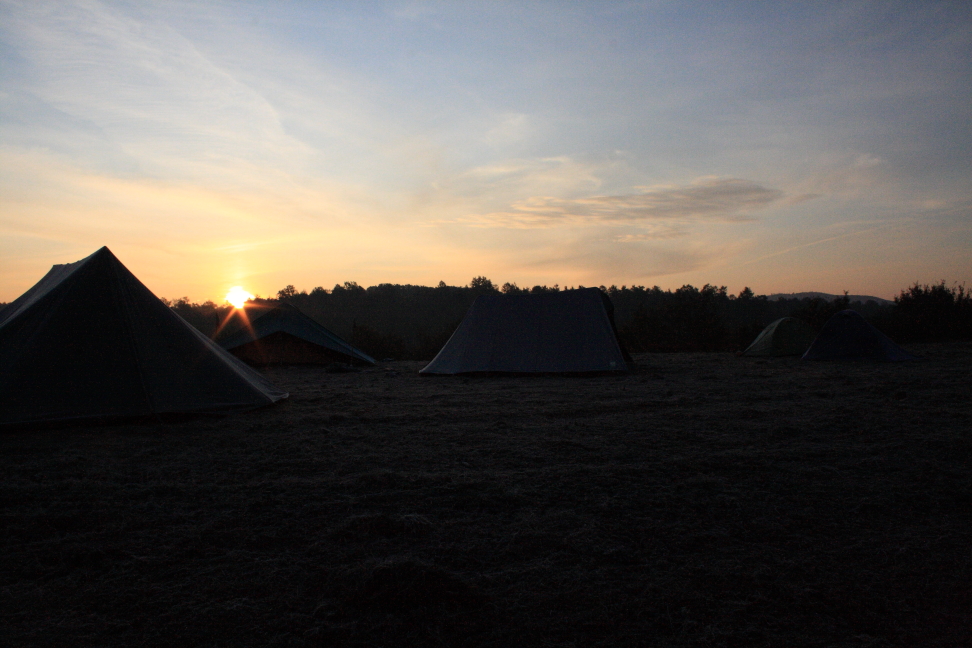
Secondly, lived. The Greek uses the term eskenosen, from the root skene which first of all means tent. So it is not so much some major dwelling, but a humble abode, which figuratively may also mean the human body (e.g. 2 Peter 1,13-14). We could keep this image by translating pitched his tent. Perhaps, the Evangelist has in mind also the tent of the presence of God in the journey across the wilderness from Egypt to the Promised Land.
Meditatio
At this stage, it is good to re-read the text slowly, and stop stop to reflect and meditate on some questions:
- We are reminded that God does not leave creation, does not abandon it. How do I feel before a God who takes care of me, a creature?
- The birth of Jesus promises a new creation. Where, in my life, do I seek a renewal of creation?
- What are the shadows in my life? Where do I experience God’s light? Am I afraid of the aspects of darkness within me? Do I really believe that God has overcome darkness?
- The text reminds us that we are called to life as children of God. What feelings does this call bring up within me?
- The Word of God became flesh — and the body become a temple of God. Do I respect my body and that of others? Do I live my embodiedness in a healthy way morally/physically?
- God “pitched his tent among us”. Do I experience God as God-with-us … or is my God still distant, absent in my life?
Oratio
I let my reflection then flow into prayer. What would I like to say to the Lord? What am I grateful for? What would I like to ask? Which graces? Does anything leave me perplexed? Where would I like to ask for forgiveness?
I may, above all, pray for the grace:
O most merciful redeemer, friend and brother,
Saint Richard of Chichester (+1253)
may I know thee more clearly, love thee more dearly,
and follow thee more nearly, day by day. Amen.
I remain in conversation, without any hurry, and speak with the Lord in the words I find in my heart.
Contemplatio
At the end, I stay in the presence of the Lord. I relish in that presence, allow my prayer to become increasing a prayer of the heart.
I conclude with another ancient prayer:
Soul of Christ, sanctify me
Body of Christ, save me
Blood of Christ, inebriate me
Water from the side of Christ, wash me
Passion of Christ, strengthen me
O good Jesus, hear me
Within thy wounds hide me
Permit me not to be separated from thee
From the wicked foe defend me
At the hour of my death call me
And bid me come to thee
That with thy saints I may praise thee
For ever and ever. Amen.
This lectio was originally written in Italian and published on 23 December 2016.
 Nova et vetera
[…] [English] […]