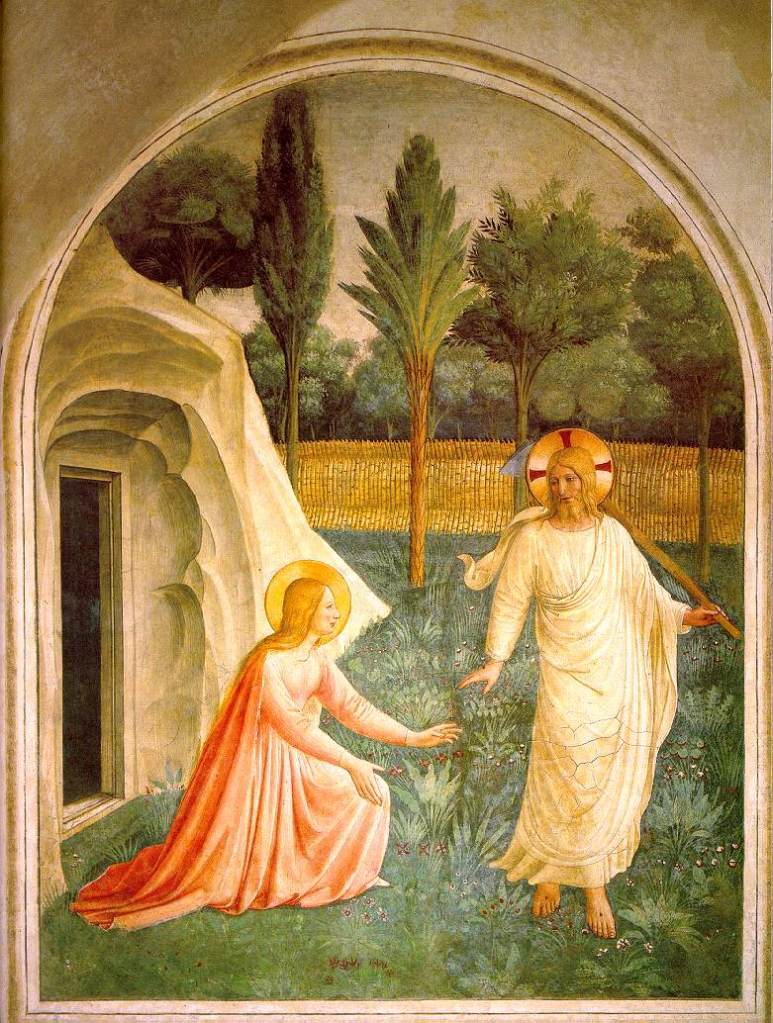
“Noli me tangere …” Sacred Art for our times
[Image: https://commons.wikimedia.org/wiki/File:Angelico,_noli_me_tangere.jpg]
[Italiano]
“Noli me tangere …” “Do not touch me …” Seems like the appropriate art for our times, as we live (at least here in Italy) school closures, quarantines, and a thousand precautions. Dark humour and irony apart, as the Italians would say “coraggio!” in these difficult times! It is hard to live the closure of schools/university, and the suspension of so many activities. Hard to walk around Rome — now a half deserted city. Perhaps, choosing to live this times of “quarantine” with the spirit of Lent or “Quadrigesima” — a quarantin-gesima [1] — may help us live it with a better attitude. As Christians, we are equipped with the right tools: fasting, prayer and charity.
Let’s start with fasting. Fasting requires me to deprive myself of what is usually good and right. It helps me become aware of where I seek what is extra, superfluous (taking away what is superfluous is, actually, temperance). Fasting is not only about food. We are called to fast with the closure of schools and universities, with the suspension of so many activities. We are called to do so not so much for ourselves — the younger, and healthier have (relatively) little to fear, but to protect the other, the elderly, the immunocompromised, those whose health is more frail. So, I take away what is mine, for the good of the other: fasting and charity go hand in hand. These are times for responsible (and often uncomfortable) decision-making, a care for the common good of society, an attention to those who are weaker, who — in such a health situation — risk suffering because of the cavalier attitude of some. These are times to understand what it means to be responsible for the good of the other (and perhaps not only now).
Fasting is also a reminder not to be self-centred and selfish. Alas, time of crises can also bring out the worst in us. It is useless to close schools if we then cannot be bothered, and continue to do what we like, with the risk of increasing the spread of infection. The fifth commandment — thou shalt not kill — requires us to do more. If I, who am healthy, act in a cavalier manner, putting others at risk, am I not like a drunk driver who risks not only his life and that of many others? So I choose to fast, to withdraw from what I usually do — from what I love to do — in an act of solidarity with the other.
Prayer. But do not pray to change God. If your god is so mean, he’s not worth praying to. Prayer changes our hearts, with God’s help. It is changes our attitude, making us less selfish and self-centred. Prayer helps prepare us to live with right intention our fasting and charity. Prayer isn’t in public ostentation, but in the inner most sanctuary of our heart. Prayer teaches us solidarity with others, just as Jesus shows solidarity with us. For some, these days will also mean a Eucharistic fast — deprived of access to receive the sacrament. Let this be an occasion for deeper prayer, offered unto the Lord.
Finally, or rather, at the apex, charity … and I don’t mean cold hard cash, but love that is active. Love shows itself in depriving myself of what is my right for the good of other (as in the closures, suspensions and various quarantines). Charity is not being greedy, emptying the shops because I can, forgetting those need to buy in small quantities as they cannot otherwise afford it. Greed and selfishness is accumulating masks and disinfectants — you never know! — perhaps depriving those who truly need them.
Charity does not consist only in not doing what is harmful, but positively doing what is good. Perhaps I care for the elderly, who feel a particular sense of isolation — why not call them on the phone? Ask if they need you to buy them something?
Charity draws us out of ourselves, our self-centredness, to think of others. Rome, so far, is living a surreal moment, but is still (relatively) little effected. Things are surely tougher in North Italy (and elsewhere around the world) that are far more directly hit. Good to remember those who — as is the case with medical professionals — are on the front line. Those who have lost their loved one, or see them in intensive care, unable to embrace them, and help them.
I add also two other elements …
Humility, against the presumptuousness of knowing everything, against cavalier behaviour. Forget conspiracy theories and strange ideas, and let yourself be guided by trustworthy sources, by experts (medical and other) in the field. No, there are no magic answers, but — as a man of science in my field — I trust far more those who have spent years studying their subject, than the oracle (or, rather, echo chamber) that is the internet. Even this is humility.
As a scout, I dare add too that these are times where we should remember that the “scout smiles and whistles under all circumstances” (as B.-P. would put it). Not because we’re stupid or insane, nor because we’re cavalier about it, but because together, with the right spirit, difficulties can be faced with a sense of responsibility.
Notes
[1] Apologies. They word play works better in the original version in Italian!
 Nova et vetera

[…] [English] […]