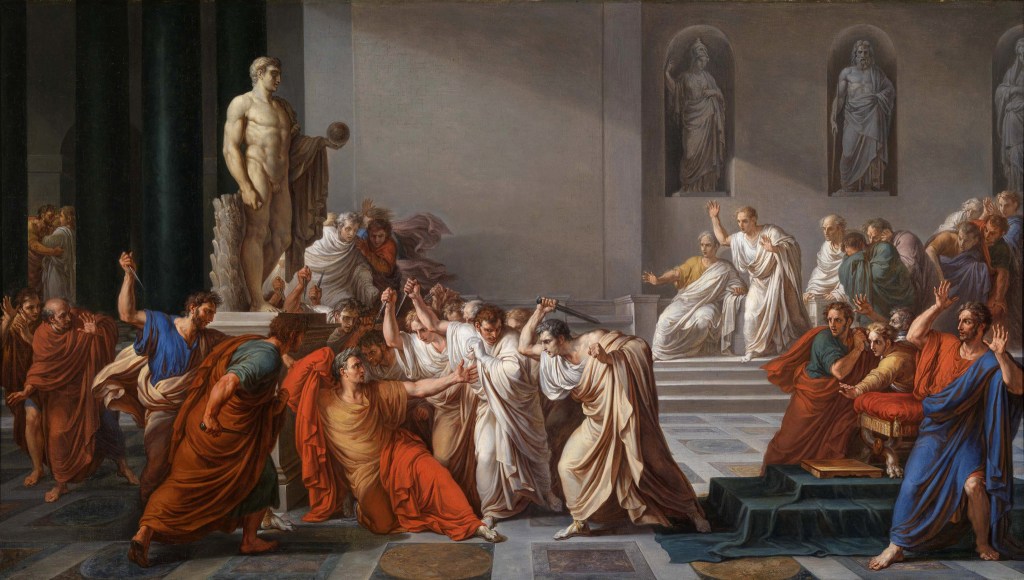
The Death of Julius Caesar (1806) by Vincenzo Camuccini
Source: https://en.wikipedia.org/wiki/Ides_of_March#/media/File:Vincenzo_Camuccini_-_La_morte_di_Cesare.jpg
— The ides of March are come.
Shakespeare, Julius Caesar, Act III, scene I.
— Ay, Caesar, but not gone.
Had Caesar taken the soothsayers advice about social distancing, rather than behave in a cavalier manner, history may have taken a different twist. Dark humour apart, I thought I’d share some reflections on social distancing as part of the strategy to slow down the spread of Corona virus.
What we saw in Italy a few days back can provide a good lesson. As I wrote elsewhere, I’m sick and tired of people bad mouthing the Italians, because — on the whole — by far the vast part of the population has been very much complying. And the rules that have been imposed, while not perfect, have a an important interior logic.
#iorestoacasa = #stayathome. Yes, stay at home when you can. In some cases, you really should. But this form of “curfew” needs to understood in term of epidemiological spread, not in terms of curfew for wartime or revolution — which works with a different logic. It is not so much about staying at home per se, but reducing potential spread due to social contact. The more we reduce these contacts, the more we slow spread. Please note, I said, slow the spread — not exactly halt it — but give the time for the healthcare system to cope with the highly increased load.
Reducing contacts, that’s the aim. So, for example, it’s pointless not to send you child to school, to then send him off to private lessons (— ma jmurx jitlef xi lezzjoni miskin!), a party at a friend’s house, or head off in hordes to the public playground — with a similar range of social contact. This feels harsher when it affects our immediate relations, and the elderly are clearly at greater risk. So, work on the delicate balance is to make sure that our elderly relatives are ok, that they have what they need, but protect them as far as possible from risk (sometimes from ourselves — sounds harsh, I know). Now is NOT the time to have that lovely family gathering at your grandma’s. Find alternate ways, though — phone, or video calling on social media (many are savvy enough) — to make sure that they are not alone. Perhaps singing out on the balconies, Italian style. Loneliness is hard on everyone, especially them.
#stayathome doesn’t simply mean stay at home, lock the door and throw away the key. Even Italy’s strict measures have clearly allowed for exercise, for running, going for a walk — with a clear proviso that this should be done alone and never in groups. There is clear logic in this, but — even here — think in epidemiological terms. Your fifteen minute shopping for basic essentials in the local shop, which is necessary, offers more chance of exposure than a one hour run on your own. Fifteen minutes on the bus — where we touch common surfaces — still offer great risk than a long walk. But again, think social distancing. Your walk shouldn’t finish at local cafe’ or sitting around in the local garden. After a run that may be easier, as you probably stink anyway! Strict measures will (not just might) impact on our mental health, individually and collectively … so, please, also be kind and considerate in your judgement of others.
KEEP CALM. Panic does not help. Try and face this with calm, reasoned, logical steps. Breathe in. All countries that I am aware of are doing their best to make sure that all the essential services are guaranteed … whether it’s food, medical care, basic supplies to keep your house going, and even essential social services. And before you go ballistic if your see your local parish church open (even with masses suspended) remember that this may be one of few safe spaces for some of the more vulnerable. No need for panic buying, and please make sure to look out for vulnerable people … if this is hard on us, it’s even harder on them.
Oh, and if you’re Julius Caesar … I’d avoid going to the senate, today.
 Nova et vetera
