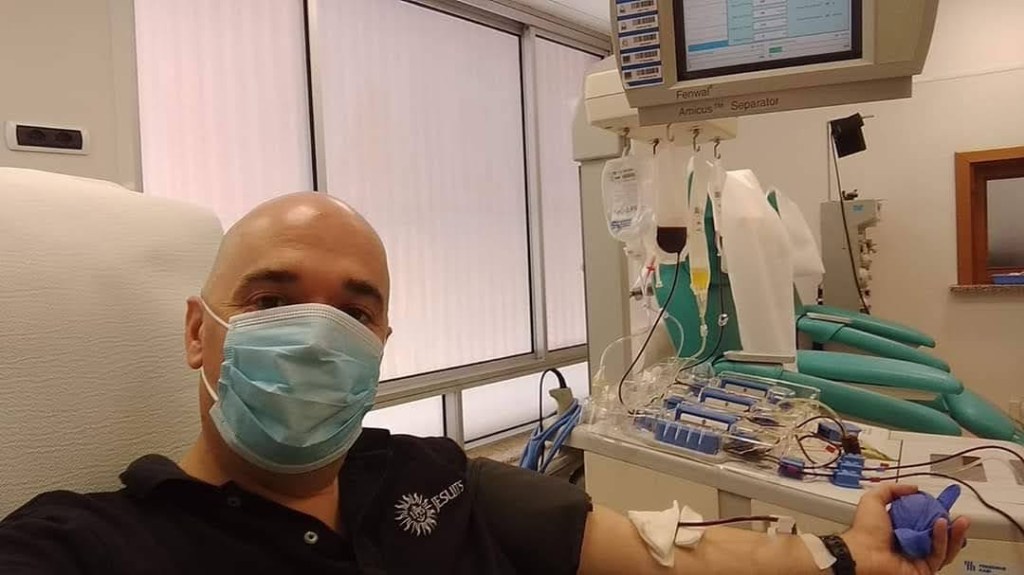
Today (14 June) is World Blood Donor day … so perhaps a post on blood donations is called for. I gave my first pint of blood back in 2005, in Malta … but didn’t become a committed blood donor until 2013, during my studies in London. I’ve since donated quite regularly, first in London, where I was based for studies, and even more so here in Rome, where I was introduced to the world of donation by apheresis.
The simplest, and noblest gift …
Blood donating is one thing I tend about to post on social media, mostly to encourage others to follow suit. It is the simplest, and noblest gift that one can give. The simplest, because honestly, other than factoring in some time (and donations of platelets or plasma by apheresis takes some 50 minutes), I don’t really do anything. At the same time, it’s also the noblest of actions, because there’s hardly anything more precious than our time and part of our very own selves.
My experience with blood donating has been great. The staff I have encountered at the blood donor centres in Malta, London, and Rome have really been wonderful, very professional, and also extremely sociable. They do their best to make all donors feel at ease, while making sure that all is done to the highest standard.
… and an encouragement to stay healthy!
One plus side for me is also that regular donations are a good reminder to take care of my own health, to be able to continue helping others. Every donation is preceded by medical screening with a doctor. Besides the standard questionnaire, the level of haemoglobin is checked, as well as blood pressure. One thing I particularly like about the system in Italy, is that the donor is also given access to the full results of the blood tests, which again helps me to keep the full picture under control.
The centres do care about their donors health. On one occasion recently, here in Italy, when one figure in the results was anomalous, I was called back a couple of days after my donation, to repeat one of the tests (thankfully, the test showed it had been a false alarm). The head of the transfusion centre who took my blood sample messaged me with the new result within a few hours, to reassure me that all was clear!

Preparing the apheresis machine 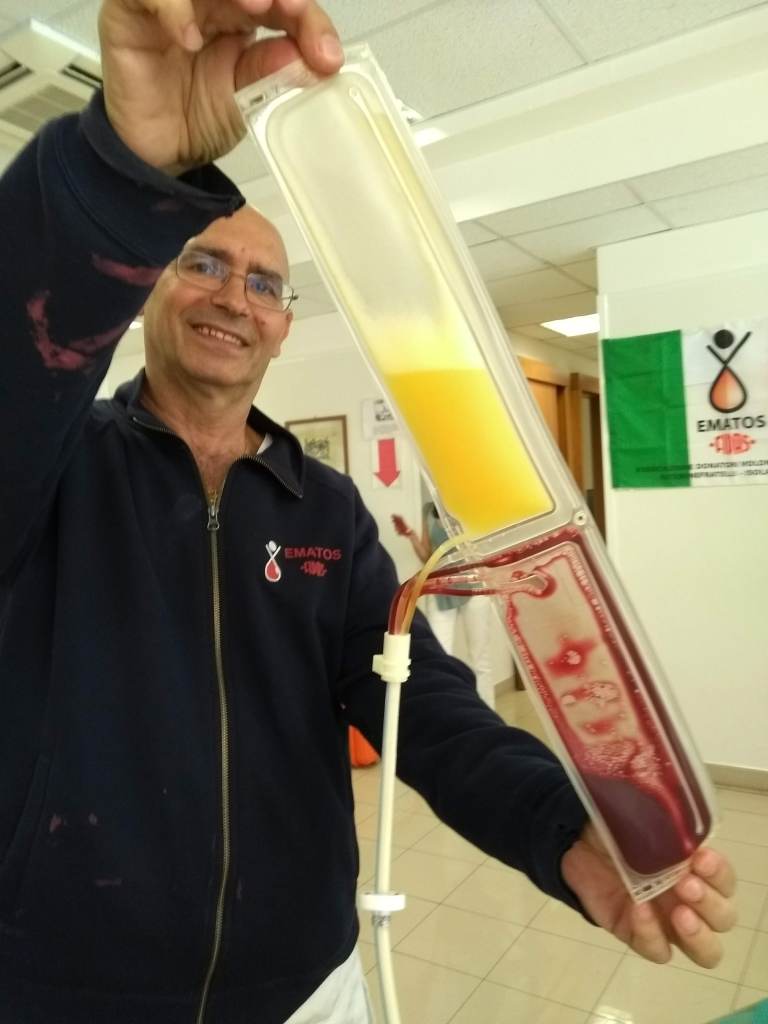
Liquid gold! 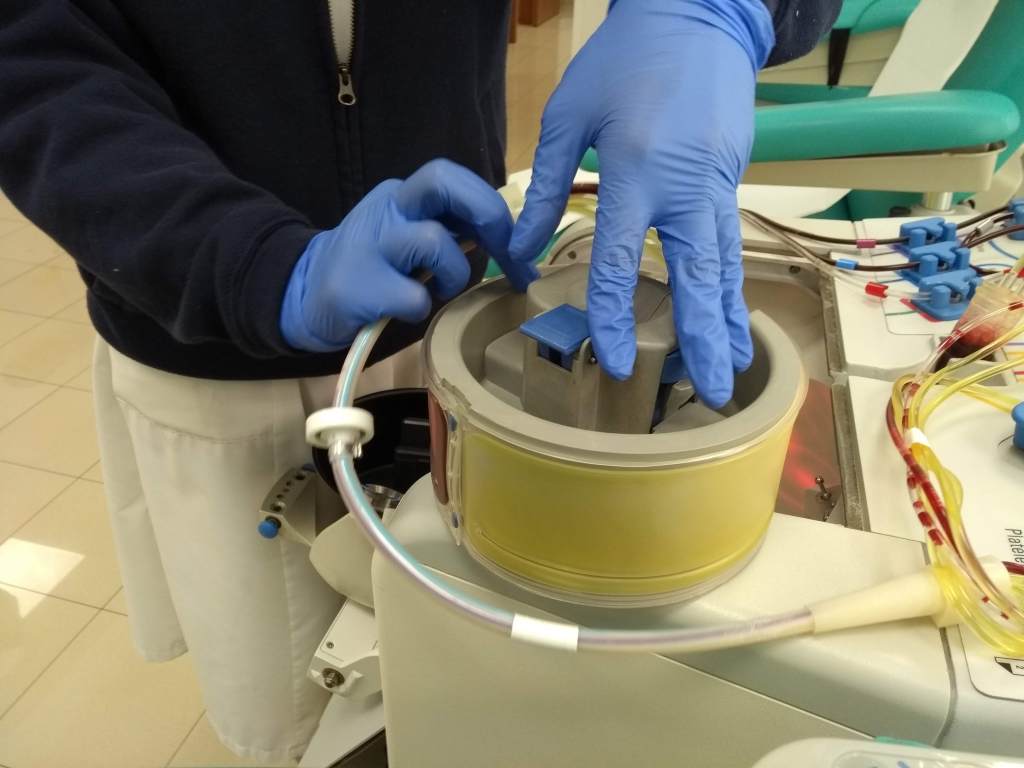
Taking out the platelets
Donation by apheresis
Here in Rome, I was introduced to the world of donation by apheresis, used in the donation of platelets, or blood plasma. It is a longer procedure — usually around 50 minutes attached to a machine. I will leave the details to the professionals, but essentially, during the donation, the apheresis machines receive the whole blood, separate the required component (platelets, or plasma, according to the case), and return the rest of the blood to the donor. At the end of the donation, there’s either a bag of plasma — the colour of some fine barrel aged whisky, or a small pouch of liquid gold — with the all too precious platelets. The procedure is totally safe, since it is a completely closed and sterile circuit.
The plus side is that, since it is not a whole blood donation, the donor can be even more regular than with whole blood. It seems that my platelet count is a rather healthy one, and the nurses are quite pleased with my veins — making it easier for them to get the needle in, and easier on me to! Anyway, the medical staff at these centres will explain all you need to know, so do not worry!
A bitter-sweet feeling
There is a particularly bitter-sweet awareness to it all. I find blood donor centres to be rather cheerful places, with great staff, and with many volunteer donors giving their time and their blood to help others. At the receiving end, though, are more difficult stories — patients with various health issues, who need blood transfusions or blood components of different kinds.
For me, it hits hardest with platelet donations, since I’m well aware that these are generally used for critically ill patients, often patients with cancer. When the blood donor centre suggested platelet donations on the last two occasions — I usually let the centre decide what is best for them — I know well was that means!
Having lost friends — even my age and younger — to cancer, it cuts closer to home. It reminds me of a responsibility — while being grateful for my good health — to do my part to give others more of a fighting chance with theirs.
I cannot repeat it enough: if you can, donate blood. It saves lives!
If you can, and would like to give blood, please check with your nearest blood donor centre. Here are some:
In Malta: Blood Donor Centre, Guardamangia. https://deputyprimeminister.gov.mt/en/nbts/Pages/Home.aspx
In the UK: NHS Blood Donation — https://www.blood.co.uk/
In Rome: Ematos-Fidas — https://www.ematos.it/
 Nova et vetera
Keep it up. Well done 👍
Wow! That’s great Father. I remembered donating blood just once during my seminary formative days. Was so scared prior to the donation but was very ok afterwards. I was happy it was used to restoring life to an accident victim. But it has not occurred to me that I should voluntarily do this charity even when no critical situation calls for it. Now I have learnt and also the aspect of keeping healthy which you elucidate in your writing. Thanks alot.