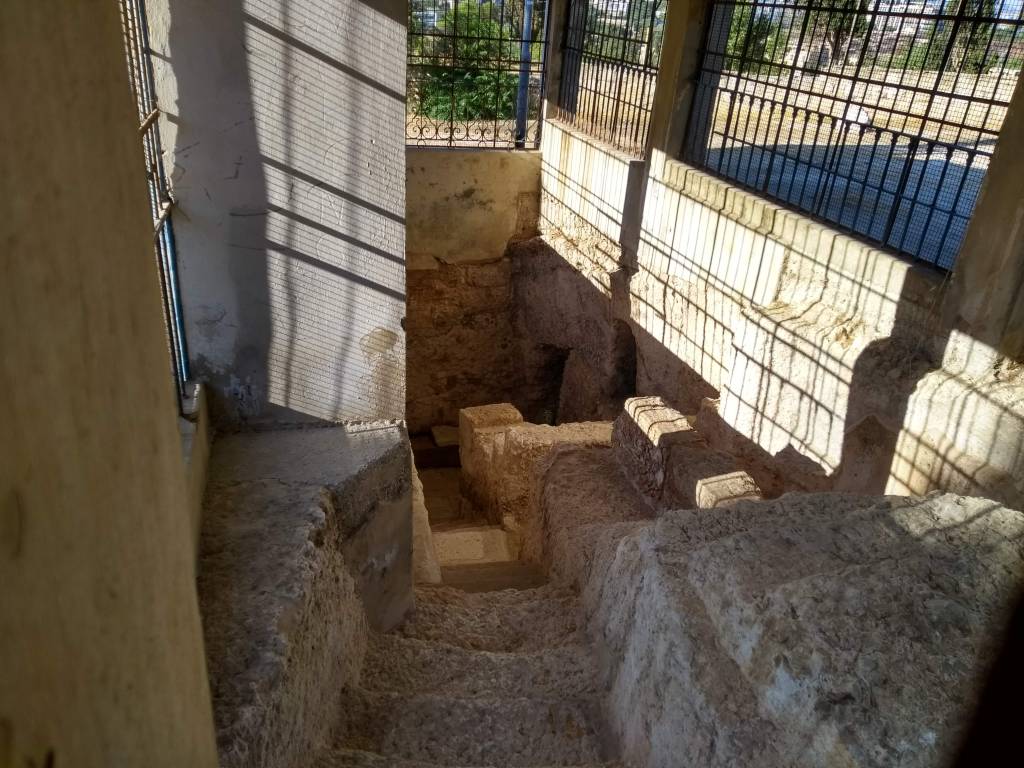
“Hermitage” on Mount Sion. Photo: J.M.Briffa (CC BY-NC-ND 4.0).
Jerusalem is so steeped in history that it is easy for some of the minor sites to fall by the wayside, and be nearly forgotten. On one of my recent walks to explore the back-roads on Mount Sion, I stumbled upon one such site, right outside the Last Supper Room / King David’s Tomb complex, to the south, in the Greek Garden. It is clearly a known site, protected by a concrete roof and iron railings. As I got home to try and track some information down, I could not find it — at first — in any publication, but it seemed odd for a site in such a prominent place to be unpublished, so I looked further …
The walk forms part of a bigger project. In recent weeks, I have been looking into several sites in Jerusalem, and how they were understood by pilgrims in the 16th century. My focus, actually, is St Ignatius’ pilgrimage in 1523, to create a sort of guide-book — Pilgrims with Iñigo in the Holy Land (online, for now), to help us see Jerusalem through the eyes of the 16th century pilgrim.
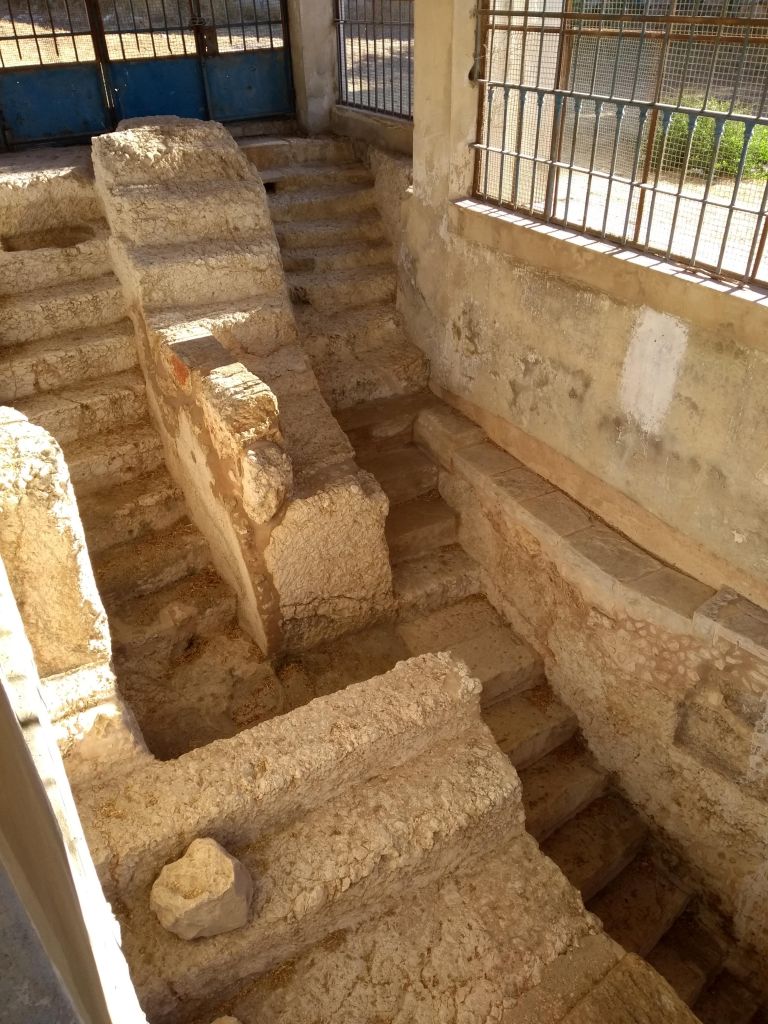
“Hermitage” on Mount Sion. Two sets of rock cut stairs, re-cutting an earlier wider staircase. The staircase on the left shows signs of plastering. Photo: J.M.Briffa (CC BY-NC-ND 4.0).
Google maps marks it as “First Church Greek Orthodox”, but this label is rather fanciful. No information about this site is present on the Greek Orthodox Patriarchate’s own website, where the various Greek orthodox shrines and monasteries are listed, as well as major pilgrimage sites, including those in the hands of other churches. While it protected as a chapel, it is clearly not a major site for the Greeks themselves.
Taking my search further, I started with the usual sources. I wasn’t expecting it to be in guidebooks, and of course, it is not listed — not even Murphy O’Connor’s trusty archaeological guide. It is not listed in the Jerusalem volume of the Archaeological Survey of Israel [1]. Trawled through several books and volumes, but seems generally unlisted.
Then, I thought that the Benedictine Fr Bargil Pixner might have something. He lived on Mount Sion at the Dormition Abbey, a neighbour to the site, and dug the “Essene Gate” in the Protestant Property just below the first rock scarp. His theory about an “Essene Quarter” was likely to interest him in such a site, but even here, very little was forthcoming:
There are several interesting archaeological items further east in the same Greek garden that have been covered with a cement roof, but so many changes have been made in later periods that it is difficult to fathom what the original designation might have been.
Pixner, “An Essene Quarter”, p. 272
My hunch that such a site could hardly be unknown was right. My best lead was Max Küchler’s Jerusalem (p. 647-648), who led me back to the original publication by the Dominican Fr F.M. Abel of the École biblique, who wrote about the site back in 1911!
Let’s get back to the site. The place is quite intriguing. Two sets of stairs lead down to a first landing, with some clear signs of plastering. Instinctively, an archaeologist in Jerusalem thinks miqveh (Jewish ritual bath) on seeing the two sets of steps in the upper part, but in this case it is less easy, since the site is undoubtedly modified and adapted: these steps are cut into an earlier wider staircase. The plan by Fr Savignac shows that the right hand staircase has been modified since his plan in 1911.
From this first landing, a further set of stairs leads down to a lower level, with an altar visible in a niche on the eastern end, and an entrance leading to the west. Back in 1911, the altar table was missing, and a cross painted in red was still clearly visible. Fr Abel quotes the Greek owners who state that the name Pamphilos in Greek was visible at the time of discovery.
This first space, open to the sky, may have been a re-cut water cistern. The spring of an arch suggests that it was roofed at some point. The doorway and window to the west lead into a second re-cut cistern, as evident from the original opening in the roof, and a 5 metre tunnel connecting a further third reused cistern, with the tell-tale opening in the roof, the original opening into the cistern, which may have well served as a skylight to the repurposed space.
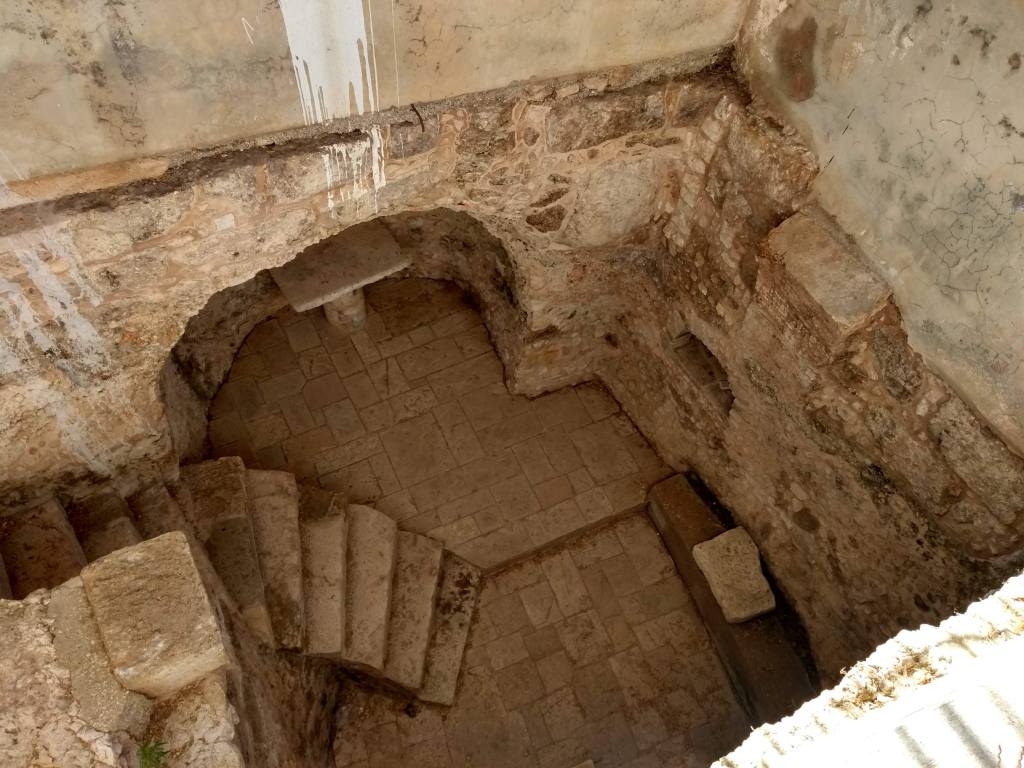
“Hermitage” on Mount Sion. Niche with altar. The column is ancient, but the altar table is not original, since it is absent during the visit by Fr Abel in 1911. Photo: J.M.Briffa (CC BY-NC-ND 4.0).
Leaving aside the fanciful suggestions, the most appropriate reading is given already by Fr Abel. In his view, this site represents one of the many “hermitages” established by monks around the 4th/5th century AD around the “Mother of All Churches”, as witnessed, for example, by Bishop Eucherius of Lyons to the priest Faustus:
[Mons Sion] cuius in vertice planitiem monachorum cellulae obtinuerunt ecclesiam circumdantes, quae illic fertur ab apostolis fundata pro loci resurrectionis dominicae reverentia, eo quod ibi promisso quondam per Dominum paracleto repleti sunt spiritu
[Mount Sion] whose flat area at the top is occupied by monks’ cells surrounding a church, which, it is said, at that place was founded by the apostles for the honor of the place of the resurrection of the Lord, because it was there, as promised before by the Lord about the Paraclete, that they were filled with the Spirit.
Eucherius, Letter to the Presbyter Faustus (early 5th c.) [trans. Arnold vander Nat]
This would fit well into the pattern of the period since we should not imagine monastic life in terms of the later, far more structured foundations. Monks and hermits often lived in caves, adapted tombs, cisterns, and other makeshift habitation. What is interesting here, is that it may represent anchoritic life not in the seclusion of the desert, but in the very heart of Jerusalem.
Notes:
[1] Site no. 405, Har Ziyyon (Mount Zion), mentions Miqva’oth, but the descriptions indicates that they are the ones in the Protestant Cemetery further down.
http://survey.antiquities.org.il/index_Eng.html#/MapSurvey/63/site/13714
References:
Abel, F.M.,“Petites découvertes au Quartier du Cénacle a Jérusalem” Revue Biblique VIII (1911), 119-125.
Küchler, M., Jerusalem: Ein Handbuch und Studienreisefuhrer zur Heiligen Stadt (Orte und Landschaften der Bibel). Vandenhoeck & Ruprecht, 2007.
Pixner, B., “An Essene Quarter on Mount Sion?” pp. 245-284 in Studia Hierosolymitana in onore di P. Bellarmino Bagatti. I. Studi archeologici. SBF Collectio Maior N. 22. Jerusalem, Franciscan Printing Press, 1976.
 Nova et vetera
Wishing you success in this archaeological endeavor. Recalling my beautiful archeological experience with you at the Holy Land.