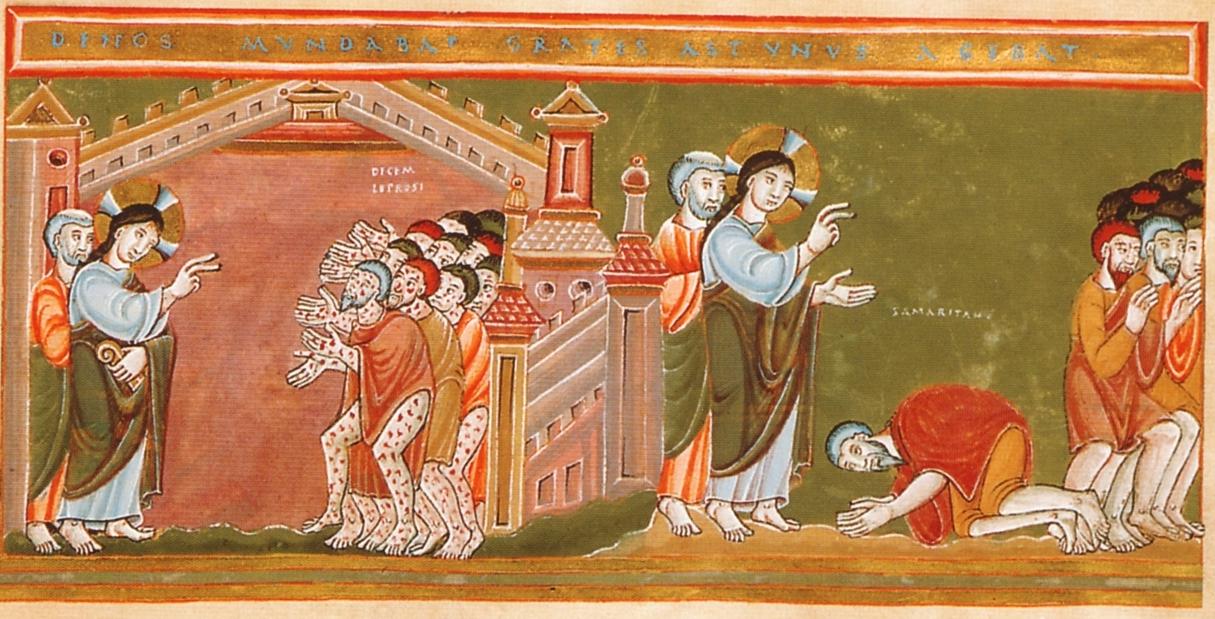
[11] On the way to Jerusalem Jesus was going through the region between Samaria and Galilee. [12] As he entered a village, ten men with a skin disease approached him. Keeping their distance, [13] they called out, saying, “Jesus, Master, have mercy on us!” [14] When he saw them, he said to them, “Go and show yourselves to the priests.” And as they went, they were made clean. [15] Then one of them, when he saw that he was healed, turned back, praising God with a loud voice. [16] He prostrated himself at Jesus’s feet and thanked him. And he was a Samaritan. [17] Then Jesus asked, “Were not ten made clean? So where are the other nine? [18] Did none of them return to give glory to God except this foreigner?” [19] Then he said to him, “Get up and go on your way; your faith has made you well.”
Luke 17,11-19
Jesus’s question — where are the other nine? — takes me quite by surprise. Jesus sounds to me quite irritated, even touchy. So much for doing good for it’s own sake rather than to receive thanks! Frankly, he’s also rather unfair. They were doing exactly what he had asked them to do: Go and show yourselves to the priests. I see all this as an invitation to study and pray the passage — and a good opportunity to propose a lectio on the passage from today’s Gospel reading.
Before we start — especially for new readers — some practical advice on how to pray (follow link). As usual with Lectio Divina, we start with a slow attentive — and prayerful — reading of today’s Gospel passage, before moving on to some comments.
Lectio
Once we have read the text slowly and careful, we can highlight some key points.
[11] On the way to Jerusalem. Jesus is on his final journey to Jerusalem, where all will be fulfilled. The itinerary, through the regions of Galilee and Samaria, is not entirely clear. The next city where we will find Jesus is Jericho.
[12] As he entered a village, ten men with a skin disease approached him. Keeping their distance … Persons with skin disease (the “lepers” of older translation) had to live apart from others for fear of contagion. Therefore, they stood at a distance.
[13] “Jesus, Master, have mercy on us!” The exact meaning of the lepers’ request is not straightforward. It could be a simple request for alms. They do recognize him as a master/teacher, but there is no explicit request for healing.
[14] “Go and show yourselves to the priests.” Jesus’s words might seem strange to us, but someone from a Jewish (and Samaritan) background would be familiar with the prescriptions of Leviticus 13, where it is the priest who has the authority to declare whether the person is healed and therefore ritually pure. Read this way, Jesus’s words are bold: he sends them to the priest before the healing occurs!
[14] And as they went, they were made clean. Curiously, in this story, Jesus does not approach, he does not touch. They are not even healed in his presence, but only along the way.
[15] one of them, when he saw that he was healed, turned back. Realizing what had happened, one stops and returns to Jesus.
[15-16] praising God with a loud voice. He prostrated himself at Jesus’s feet and thanked him. Returning praising God, and thanking Jesus, go hand in hand. The Samaritan recognizes God’s action, and Jesus as the intermediary of this power. The man prostrates himself — a sign of profound respect reserved for persons in great authority or for the Divine.
[16] And he was a Samaritan. For the Jew, the Samaritan is the other. Almost worse than the foreigner, because he is different among us: the one who does not observe God’s law as it should be, we might say the heretic.
[17] “Were not ten made clean? So where are the other nine?” Jesus’s question is clearly rhetorical. Ironically, he knows very well where they should be: they are going to the priests, as he had asked! It therefore pushes us to ask further.
[18] “Did none of them return to give glory to God except this foreigner?” Here it is the foreigner who recognizes the extraordinary nature of what has happened to him. Returning to give thanks means, first of all, not taking God’s action for granted, knowing how to recognize them, and knowing how to express gratitude to God who has acted. At the root of non-gratitude is often habit, taking things for granted, taking them as given.
[19] “Get up and go on your way; your faith has made you well.” Jesus ask the Samaritan to get up (he is still prostrate) and sends him on his away. The ambiguity of the last sentence is interesting: in Greek the terms save and heal/make well are the same. We could translate it as: your faith has saved you … healing here led him to recognize God’s action through Jesus, going beyond simple healing, opening the doors of salvation.
Meditatio
Before moving on to the next stage, I invite you to reread the passage, enriched by the various comments. We can then reflect on the passage and on ourselves, led by some questions. You can, of course, add others that emerge from your prayer.
- Where do I see myself as diseased in my life? Where do I need healing? What keeps me distant from others, from God?
- What is my prayer to God? Do I dare to pray? Do I dare to ask for great things? Or am I already too resigned, ultimately discouraged in my prayer?
- These ten men were healed along the way. Do I trust God enough to undertake the journey, confident that God will accomplish in me what I don’t yet see?
- The Samaritan recognizes the gift he received, returns, and gives thanks. Do I open my eyes to see God’s grace in me? Do I return to give thanks?
- The other nine do not return. Perhaps because they struggle to recognize God’s action. Perhaps because they take God’s action for granted, and are therefore incapable of recognizing its extraordinary nature. What about myself? Where do I find myself taking my journey of faith for granted? Where have I become too accustomed?
- Where do I experience being healed? Being saved?
Oratio
I allow my reflection to transform into prayer, into a personal conversation with the Lord, as a friend speaks to a friend. I speak to the Lord about what comes up within me: perhaps praising and thanking God for a gift received, or asking for a grace, asking for forgiveness.
I also listen. What do I sense within me that the Lord is trying to tell me in the depths of my heart? What words of comfort, what words of encouragement? Where is it that God gently pushes me to go beyond those limitations I see, to grow in faith, hope, and charity?
Contemplatio
Finally, I stay in silence in the Lord’s presence. A full silence, like friends, or lovers, who simply enjoy being together, where words are no longer necessary.
I close my time of prayer with the Anima Christi:
Soul of Christ, sanctify me
Body of Christ, save me
Blood of Christ, inebriate me
Water from the side of Christ, wash me
Passion of Christ, strengthen me
O good Jesus, hear me
Within thy wounds hide me
Permit me not to be separated from thee
From the wicked foe defend me
At the hour of my death call me
And bid me come to thee
That with thy saints I may praise thee
For ever and ever. Amen.
 Nova et vetera

[…] [Lectio in English] […]