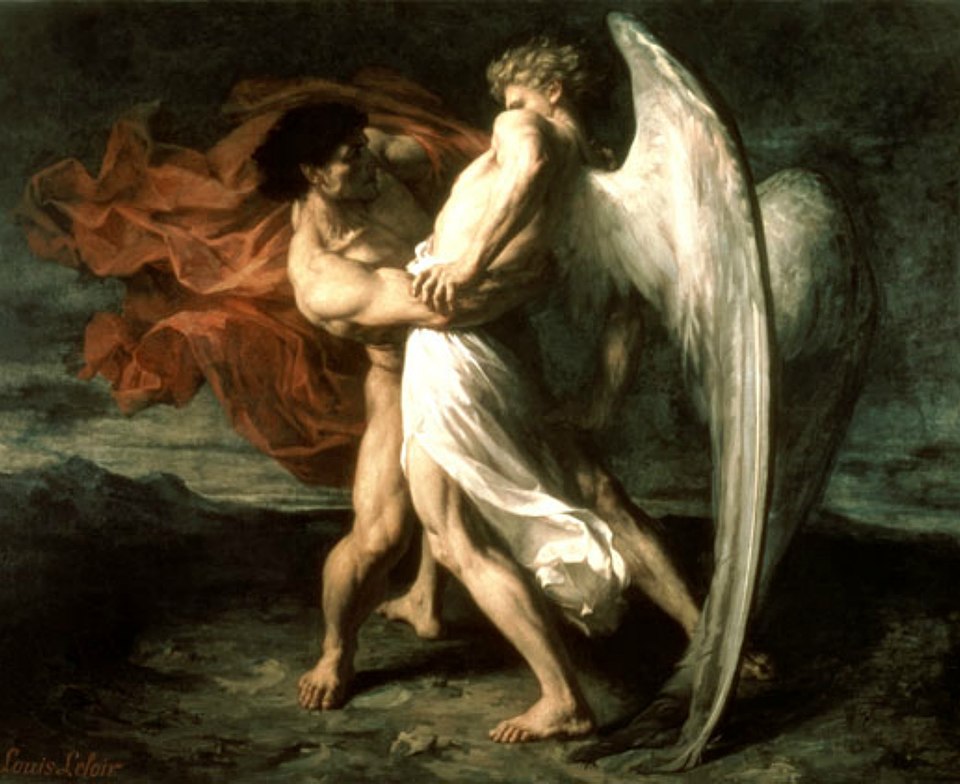
The Bible is a rich and varied anthology that speak of God’s relationship with humanity … but it is not always easy to read or understand. One of the somewhat odd passages is a scene in the book of Genesis, in the narrative cycle concerning the patriarch Jacob. Here Jacob finds himself wrestling with an enigmatic figure, a struggle that — I find — can speak to our own internal struggles. The Lectio I propose here takes this more spiritual approach.
Before moving on, for those new to this blog and to Lectio Divina, you might find it helpful to take note of some practical advice on how to pray (follow link).
Lectio
As always, the first step is to read the text. A calm, slow reading, meditative reading, with an eye for the detail:
[22] The same night he got up and took his two wives, his two maids, and his eleven children, and crossed the ford of the Jabbok. [23] He took them and sent them across the stream, and likewise everything that he had. [24] Jacob was left alone; and a man wrestled with him until daybreak. [25] When the man saw that he did not prevail against Jacob, he struck him on the hip socket; and Jacob’s hip was put out of joint as he wrestled with him. [26] Then he said, ‘Let me go, for the day is breaking.’ But Jacob said, ‘I will not let you go, unless you bless me.’ [27] So he said to him, ‘What is your name?’ And he said, ‘Jacob.’ [28] Then the man said, ‘You shall no longer be called Jacob, but Israel, for you have striven with God and with humans, and have prevailed.’ [29] Then Jacob asked him, ‘Please tell me your name.’ But he said, ‘Why is it that you ask my name?’ And there he blessed him. [30] So Jacob called the place Peniel, saying, ‘For I have seen God face to face, and yet my life is preserved.’ [31] The sun rose upon him as he passed Penuel, limping because of his hip. [32] Therefore to this day the Israelites do not eat the thigh muscle that is on the hip socket, because he struck Jacob on the hip socket at the thigh muscle.
Genesis 32,22-32 NRSV
Let’s begin with the context of the story. We are in the midst of the narrative cycle of Jacob. After several years living with his father-in-law Laban (Jacob had married his two daughters, Leah and Rachel), Jacob fled, but Laban pursued him, and finally they came to an agreement. Now, Jacob, returning to Canaan, has to face his elder brother Esau, from whom, years earlier, he had stolen the birthright and the blessing of his father Isaac. Understandably, Jacob fears this encounter. It is in this context that Jacob is crossing the ford of the Jabbok at night, with his family and his flocks.
[22] The same night. This is not just a chronological note. Night is the time when things are done in secret, a time of fear, but can also be a time for intimacy.
[24] Jacob was left alone. The text does not tell us why Jacob does not stay with all the others, but this narratively creates the space for the scene that follows.
[24] a man wrestled with him until daybreak. This man, this figure, seems to emerge from nowhere (and, for that matter, return to nowhere). He wrestles with Jacob, and it is not clear why. His identity is not revealed to us. The fight lasts until daybreak, that threshold between night and day.
[25] he did not prevail against Jacob. When we get some sense of this figure’s identity, it will seem even stranger that he is unable to defeat Jacob. Several commentators try to justify this, trying to come up with a reason, but the text itself leaves us without an explanation as to why it seems such an evenly matched fight, where neither can gain the upper hand.
[25] he struck him on the hip socket; and Jacob’s hip was put out of joint as he wrestled with him. Toward the end of the fight, we well could say that this enigmatic figure cheats, dislocating Jacob’s hip. This seems to further emphasize how truly equal the fight was, to necessitate such an act. But Jacob, nevertheless, does not let go.
[26] ‘Let me go, for the day is breaking.’ Up until now, it had been a silent scene. Now the dialogue begins, with the figure begging Jacob to let him go. It seems that such struggles should only happen at night.
[26] ‘I will not let you go, unless you bless me.’ Jacob still does not give up, and his request for a blessing seems to indicate that he has grasped something of the particular identity of this figure. Blessing is always something that speaks of an asymmetrical relationship, with a clear hierarchy. Therefore, he recognizes this figure as superior to him.
[27] ‘What is your name?’ In ancient times, much more than today, names had a very strong value. The right to know a name, even more than to give a name, confers power over the person.
[28] ‘You shall no longer be called Jacob, but Israel.’ The act of giving Jacob a new name is a clear act of authority. It is also an aetiological scene, that is, one that offers an explanation of something: in this case, it explains the name Israel. The enigmatic figure explains it like this: ‘for you have striven with God and with humans, and have prevailed.’ The true etymology of the name has been much debated, but this popular etymology is the best known.
[29] ‘Please tell me your name.’ Here Jacob dares to ask the name, placing himself on an equal footing.
[29] ‘Why is it that you ask my name?’ The enigmatic figure refuses to reveal his name, and his identity. Hence tradition often describes him as an angel, that is, a heavenly messenger. The text itself, in truth, implies that he is God himself. Divine names, in particular, can be jealously guarded, because—as I have seen—knowing the name means having authority over the person, being able to command him.
[29] And there he blessed him. The scene ends with Jacob’s blessing.
[30] So Jacob called the place Peniel. Then Jacob called that place Peniel (or Penuel). This too is an aetiology, offering an explanation of the name, which means Face of God. In the story, Jacob-Israel explains it in this manner: ‘For I have seen God face to face, and yet my life is preserved.’
[31] The sun rose upon him. This note brings the nocturnal scene to a complete close.
[33] to this day the Israelites do not eat the thigh muscle that is on the hip socket. Here too, an aetiological note, explaining one of the various ritual rules related to food, still present in Jewish kashrut.
I now invite you to re-read the text, enriched by these various insights.
Meditatio
Going beyond the meditative reading of the text, I invite you to reflect on the passage and on yourself, taking some questions as a starting point.
- The scene takes place at night, in the darkness. The night is an ambiguous space: it can be scary, but it is also a space of intimacy.
- Where have I experienced, or perhaps still experience, experiences of darkness, at night? How would you describe that night?
- Where is the night, the darkness, a space of fear, of anguish? What name can you give to this fear, this anguish?
- Where does that night also become a space of intimacy? Of profound interiority? How would you describe this encounter?
- Where do you find yourself wrestling with God?
- What experiences in your life lead you to wrestle with God?
- Where in your life do you struggle deeply with God? What questions would you like to ask Him? What frustrations would you express?
- Where do you also say to God—with Jacob—‘I will not let you go, unless you bless me.’ ?
- Where do you find yourself—despite everything—unwilling to let go?
- What is it in your life that you struggle to see as a place of blessing? Where, in particular, do you ask for God’s blessing today?
- You will no longer be called … God gives Jacob a new name. The encounter with God, often enigmatic in our lives, gives a particular word to each of us, gives us a new name.
- What word of God do you find that speaks to your relationship with Him?
- What “name” do you feel God would give you today?
- Time, the place of encounter, also becomes a sacred space.
- What are these places, these sacred spaces of encounter in your life?
- What is your Penuel called?
To these questions, you may also add others that arise from your personal reflection on the passage.
Oratio
Reading (lectio) and reflection (meditatio) are not ends in themselves, but lead us to prayer (oratio), a one-on-one conversation with the Lord. If you still find yourself wrestling with the Lord, you can also imagine the scene and let this conversation unfold by identifying with Jacob in the scene.
Speak to the Lord about what comes up within you. Discuss your struggles, your toils. Express your difficulties and frustrations. But never give up. You may also ask for grace, ask for a blessing. Perhaps, you feel the need to praise the Lord for a grace, for a gift received, and to thank him. Or maybe you would like to ask for forgiveness.
For it to be a conversation and not just a monologue, it is important to learn how to listen. This requires patience, and silence. Letting the words arise within you, without forcing them. What do I sense the Lord is trying to tell me? What word of comfort, what encouragement, what blessing? (After all, the Lord speaks in the depths of our hearts.)
Contemplation
Finally, stay in God’s presence in silence. That full, fruitful silence of those who simply enjoy being together, where words are no longer necessary, as between good friends, as between lovers.
In conclusion, you may recite the prayer Anima Christi:
Soul of Christ, sanctify me
Body of Christ, save me
Blood of Christ, inebriate me
Water from the side of Christ, wash me
Passion of Christ, strengthen me
O good Jesus, hear me
Within thy wounds hide me
Permit me not to be separated from thee
From the wicked foe defend me
At the hour of my death call me
And bid me come to thee
That with thy saints I may praise thee
For ever and ever. Amen.
 Nova et vetera
[…] [English] […]